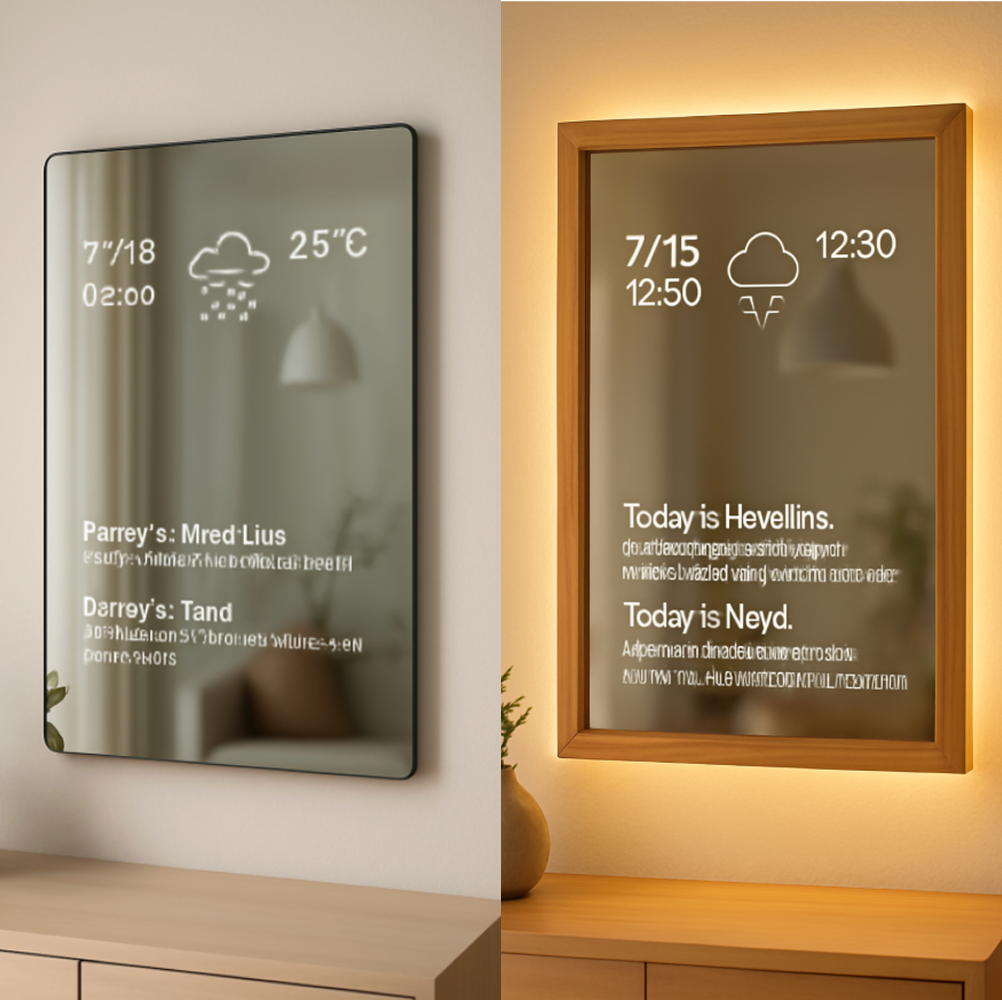
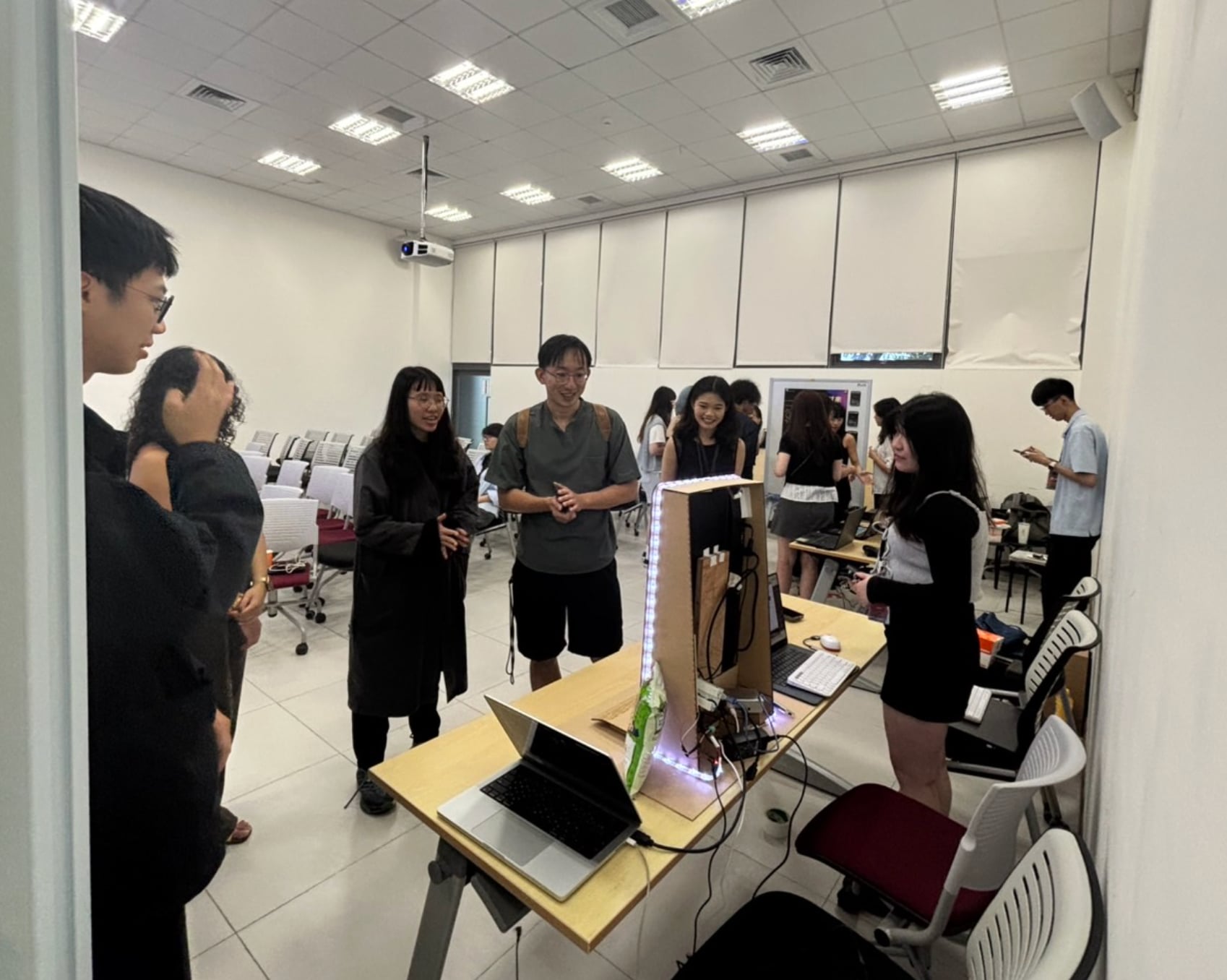
Credit: OpenHCI Workshop '25
Motivation: Enhancing Family Communication Through Technology
Modern families often struggle with meaningful communication and reflection, as busy schedules and digital distractions
reduce opportunities for genuine connection and self-awareness. Traditional methods of promoting family bonding and
personal reflection often lack engagement and fail to adapt to individual family dynamics and needs.
Our objective was to create an intelligent mirror system that uses AI-powered analysis and interactive prompts to
facilitate deeper family conversations and encourage personal reflection in a natural, unobtrusive way.
Our Product: Reflective Mirror System
The Reflective Mirror represents an innovative approach to family interaction technology, combining AI-powered analysis, Arduino hardware integration, and thoughtful design to create meaningful moments of connection and reflection. The system uses intelligent prompts and real-time interaction analysis to guide families toward deeper conversations while providing personalized insights that encourage self-awareness and emotional growth.
(For example, when family communication deteriorates, the mirror subtly responds with flickering LED patterns resembling storms. As users approach the mirror, gentle prompts appear to encourage deeper reflection on their interactions.)
The core innovation lies in the seamless integration of AI-powered conversation analysis with physical mirror interaction. During the OpenHCI workshop, our team successfully demonstrated how technology can enhance rather than replace human connection. The system's ability to provide gentle, contextual prompts for reflection while maintaining the natural flow of family interactions showcases the potential for AI-assisted communication tools that prioritize emotional well-being and meaningful relationships.
Technical Implementation
The system is designed to perform audio capture, speech-to-text, LLM-based text analysis, sensor signal processing, interactive user interface, etc. Collaborating with UI/UX Designers, Industrial Designers, Software Engineers, and Prompt Engineers, I worked as an ML Backend + Embedded Systems Engineer to design the data processing pipeline, integrate AI-powered features, and develop the embedded hardware system.

Reflective Mirror System Architecture
ML Backend [GitHub]: I built the data processing pipeline that analyzes family interaction patterns (refer to Family Communication Patterns Theory) and delivers personalized reflection prompts using Python, Flask, and AI APIs (Google Speech-to-Text, OpenAI GPT).
Embedded Systems: The Flask backend was deployed on our Raspberry Pi, and the Arduino microcontroller was used to handle sensors and physical interactions with users (e.g. flickering LED). We built the reflective + display interface by attaching a computer screen with a customized two-way mirror (inspired by Becky's video).
Frontend & UI/UX [GitHub]: The frontend was developed by other engineers, built upon the open-source Electron/Node.js-based MagicMirror framework. By leveraging MM's modular plugins, we can query time, weather, and other information via APIs, and display these modules on the mirror. The cross-platform nature of Electron allows us to deploy the web app on Raspberry Pi OS, Windows, and macOS.
LLM Prompt Engineering: In this project we used OpenAI API to generate personalized content based on the detected texts from our speech-to-text module. Engineers and designers carefully crafted the processing pipeline, specifically the details in system prompt/user prompt design, structural response formatting, context windows, and exception handling.
Takeaways
Throughout this experience, where technology meets human-centered design to create meaningful family interactions, I learned that the most impactful solutions are those that enhance--rather than replace--human connection. I will continue to explore how AI and hardware integration can be used to foster deeper relationships and personal growth in our increasingly digital world.